





After my transfers video, a lot of you have been asking about my shoulder health. So I partnered with Gem to put together a guide to shoulder health for wheelchair users.
It’s a look into how we keep our shoulders working, split into two halves: what we do to strengthen and protect them, and what we do to recover.
Every push, every transfer, every reach for the top shelf, every lift back into the car goes through the same two joints. Shoulders weren’t designed for that much work, and shoulder pain is one of the most common problems manual wheelchair users run into. Look after your shoulders, and they look after your independence.
The short answer.
Good shoulder health for wheelchair users comes down to two things. Prevent strain by pushing with good technique in a well-set-up chair, and strengthen the back of your shoulders to balance all that pushing. Then recover with stretching, heat, rest and the odd reset, so the load of each day doesn’t keep stacking up.
Why shoulder health matters so much in a wheelchair.
Think about a normal day. Out of bed into the chair. Into the car, chair in after you. Out again. Thousands of pushes. Up a ramp. Onto the couch. Back into bed.
Every one of those moves is your shoulders. And most of them are pushing or pressing down, which builds the front of the shoulder and leaves the back behind. Over time, that pulls your shoulders forward, rounds your upper back, and puts the joint in a worse position for every push that follows.
Wheelchair shoulder pain usually doesn’t come from one big injury. It builds slowly from overuse. Which is good news, in a way: small daily habits can stop it from building.
Prevention vs recovery: the two halves of shoulder care.
I split it into two halves because they do different jobs.
|
Prevent and strengthen |
Recover |
|
|
The job |
Reduce the load on your shoulders and build the muscles that protect them |
Help your shoulders bounce back from the load they’ve already taken |
|
How often |
Every push, plus training a few times a week |
A few minutes most days, plus a bigger reset each week |
|
What it looks like |
Good pushing technique, chair setup, strength work, dead hangs, desk posture |
Foam roller, heat, sauna, cold plunge, massage |
Do only prevention and you’re running the engine without ever servicing it. Do only recovery and you’re servicing an engine that keeps getting overloaded. You need both.
Prevent and strengthen.
Wheelchair pushing technique and chair setup.
This is where it starts, because you push thousands of times a day. Long, smooth strokes, letting your hands drop below the rim on the way back, and a chair set up so your elbow sits at 100–120° with your hand on top of the rim. Setup often matters more than technique.
Read more: Wheelchair pushing technique and chair setup for healthy shoulders
Shoulder exercises for wheelchair users.
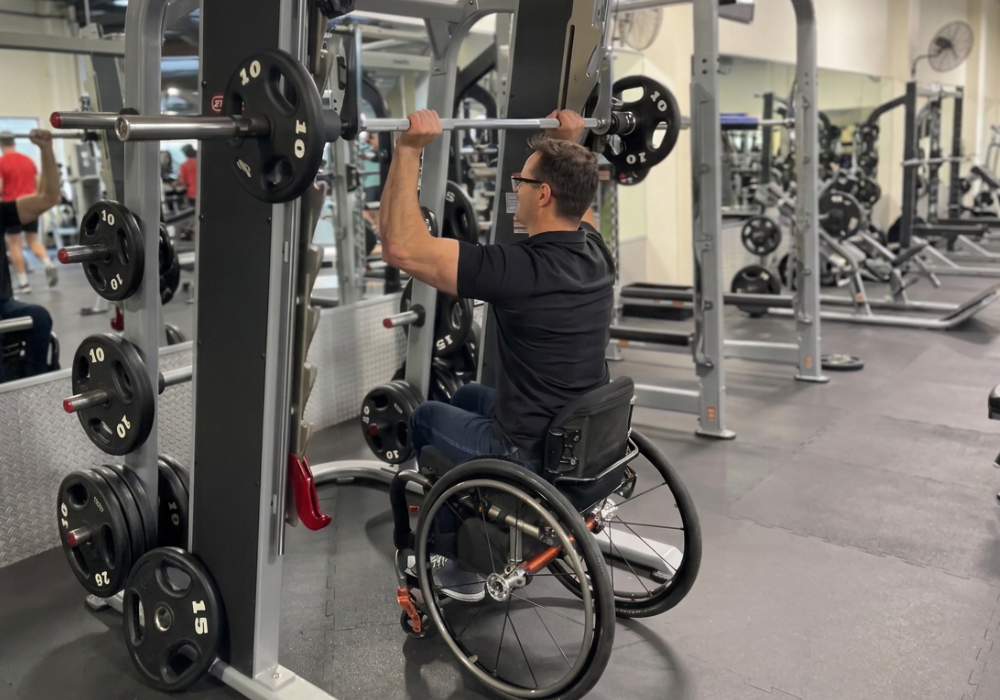
Pushing builds the front of your shoulders. My four-move routine builds the back: seated rows, pull-downs, one-arm dumbbell rows and a broom stretch to finish. That balance is what keeps them healthy, and you can do it at the gym or at home.
Read more: Shoulder exercises for wheelchair users: a 4-move strength routine
Dead hangs.
After reading about dead hangs, I wanted to try lengthening out my shoulders, so I built a rig at home: a rope, three bars and a carabiner on a beam. I hoist myself up from my chair, hang, and lower myself back down. It’s an experiment, and I’m doing it every day.
Read more: Dead hangs for shoulder health: my DIY hanging bars
Neck health and desk setup.
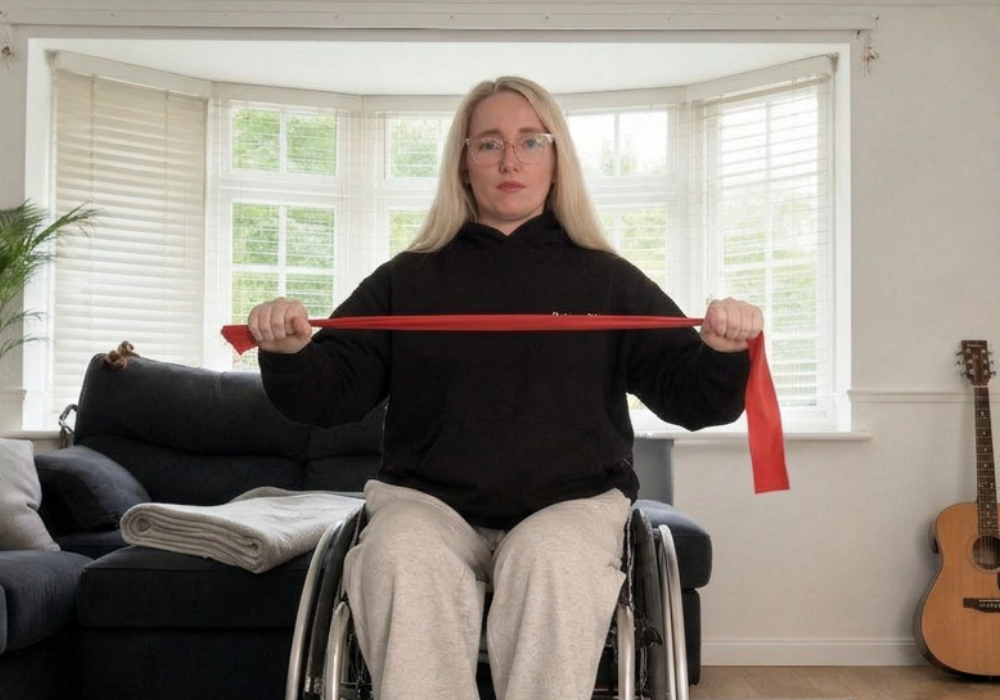
Your neck and shoulders work as a team, and a bad desk setup undoes a lot of good work. Gem shares the setup her physio helped her with (laptop stand, separate keyboard, trackpad, neck massager) and three seated exercises: chin tucks, neck roll-backs and shoulder pockets with a resistance band.
Read more: Neck health: Gem’s desk setup tips and 3 daily exercises
Recover.
My shoulder recovery routine.
Recovery for me is a mix of small daily habits and a bigger weekly reset. A foam roller every few days when my upper back feels tight. A hot water bottle in the evenings. The sauna and cold plunge at least once a week, which has become as much a mindfulness practice as a physical one. And a massage once in a while when things are really tight.
Read more: Shoulder recovery for wheelchair users: my weekly routine
When to see a physio.
Some shoulder pain needs more than good habits. See a physio or doctor if:
-
Shoulder pain lasts more than a week or two, or keeps coming back
-
Pain wakes you up at night
-
You have pins and needles, numbness or weakness down your arm
-
You’ve lost movement, or can’t lift your arm overhead
-
Pain is getting in the way of transfers or pushing
It’s also worth getting your seating and pushing technique checked by a seating specialist every couple of years, even when nothing hurts.
FAQ.
Why do wheelchair users get shoulder pain?
Manual wheelchair users rely on their shoulders for pushing, transfers, pressure relief and reaching, often thousands of times a day. Shoulders aren’t built for that load. Over time, the repeated strain, plus an imbalance between strong front muscles and weaker back muscles, can lead to overuse pain.
How can wheelchair users protect their shoulders?
Push with long, smooth strokes in a well-set-up chair, strengthen the back of your shoulders with pulling exercises, keep your desk setup in check, and build recovery habits like stretching, heat and rest into your week.
What are the best exercises for wheelchair shoulder pain?
Pulling exercises that strengthen the upper back and the back of the shoulders, such as seated rows, pull-downs and one-arm rows, help balance the load from pushing. If you already have shoulder pain, see a physio before starting so the routine fits what’s going on.
Should I strengthen or rest a sore shoulder?
It depends on the cause. Mild tightness often responds well to gentle movement, stretching and heat. Sharp pain, pain that lasts, or pain with numbness or weakness needs a physio’s assessment first.
Does chair setup affect shoulder health?
Yes, a lot. Axle position, seat height, chair weight, tyre pressure and push rims all change how hard your shoulders work on every push. Small adjustments can make a big difference.
I am a T10 complete paraplegic and acknowledge that not everyone has the function I do. Do your best with what you’ve got and continually look to improve your skills.
This guide is general information, not medical advice. Talk to your physio, OT or spinal team about what’s right for your shoulders.
Look after your shoulders, and they’ll look after you.
Happy Adaptdefying.
– Mike
About the author.
Mike Brown is a T10 complete paraplegic and has pushed a manual wheelchair every day since a spinal cord injury in 2012. He’s the co-founder and CEO of Adaptdefy, a company that designs products for wheelchair users, built from lived experience. He co-created LapStacker, the world’s first retractable carry system for wheelchairs.
Mike writes from more than a decade of pushing, transferring and training in a chair. Since his spinal cord injury in 2012, Mike has spent 14 years working out what actually helps in daily wheelchair life. The tips he shares on Adaptdefy's blog and social media come from real trial and error, conversations with the Adaptdefy community, and a commitment to passing on the knowledge.
Mike isn’t a medical professional. His posts share lived experience, not medical advice, so check with your physio or medical team before trying something new.


Leave a comment
All comments are moderated before being published.
This site is protected by hCaptcha and the hCaptcha Privacy Policy and Terms of Service apply.