

Face your fears
Here's the thing about wheelchair skills that nobody talks about. The barrier isn't usually physical. It's not strength, it's not injury level, it's not the chair. Most of the time, the thing stopping people from getting to the next level is fear.
The fear behind advanced wheelchair skills.
Every wheelchair skill has a fear threshold. The moment where the consequence of getting it wrong feels too real to push through.
For the back-wheel balance, it's the fear of tipping backwards. For a steep slope, it's the fear of losing control at speed. For the wheelie spin, it's the fear of losing the hold mid-rotation and not knowing which way you're going to fall.
These are real fears. They're not weakness. They're your nervous system doing its job. But the balance point is always just past where fear tells you to stop. That's true for every skill, every time. The people who do advanced wheelchair skills aren't the ones who don't feel fear. They're the ones who've learned to move through it anyway.
When it feels too hard, it's likely just you getting in the way. Try getting out of the way.
Facing the fear: Changing your mindset.
That fear is not irrational. It kept you safe while you were learning. When you were first finding the balance point and your spotter was two steps behind you, fear made you careful. It did exactly what it was supposed to do.
The problem is when it doesn't stand down once the skill is built. When you've got the back-wheel balance on flat ground but fear keeps you off the slope. When you've got the pop but fear keeps you from committing to the descent. That's not caution anymore. That's the thing between you and the next level.
Not going to lie, it is uncomfortable. But therein lies the medicine.
What's on the other side.
Every time you push through a fear threshold in your wheelchair skills, something shifts. Not just in what you can do. In how you move through the world.
The slope you used to avoid becomes a route. The terrain you used to navigate around becomes somewhere you can go. The things you used to need help with become things you handle. One by one, the edges of your world expand.
That's what this is about. Not the tricks. Not the technique. The freedom that accumulates on the other side of every skill you were afraid to learn.
Do your best with what you've got and continually look to improve your skills.
Facing my fear, and finding freedom.
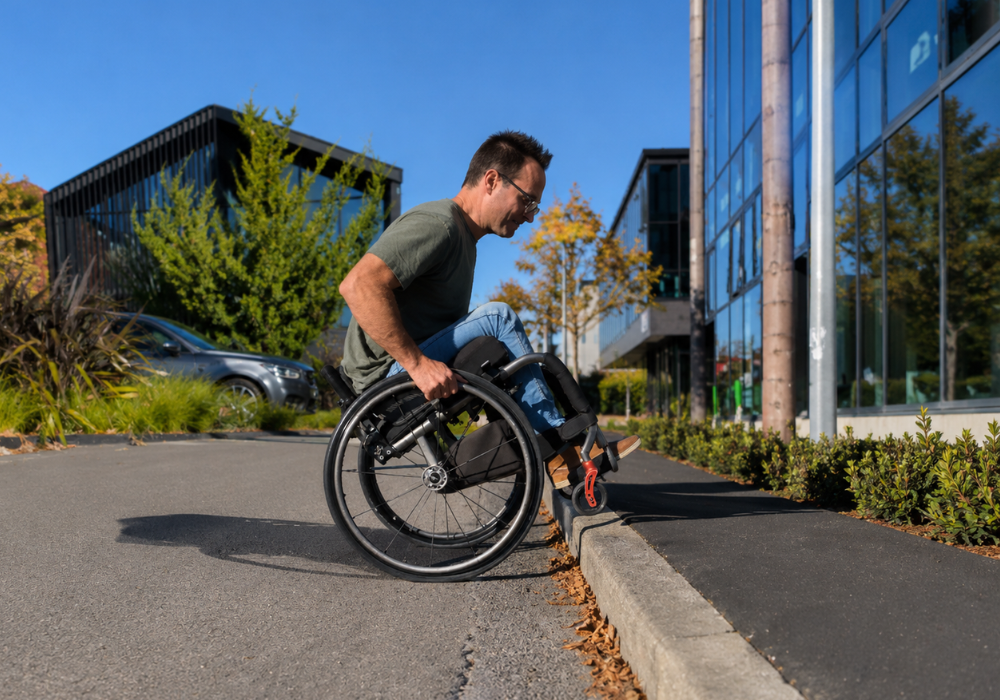
I started where everyone starts: tiny differences in levels. The join between two pavement surfaces. A lip that's barely there.
Then a small step, two or three centimetres, then a fraction more.
Each time I committed to a slightly bigger pop, felt it work, and didn't fall, the gap between the fear and the skill closed a little.
Over months, not weeks, the bunny hop built into the high wheelie, and the high wheelie slowly stopped being a skill I was practising and became something I just did.
Now I don't factor curbs into my route. I don't look for the dipped kerb, the lowered crossing, the accessible entry point around the corner.
If where I'm going is on the other side of a standard kerb, I go directly there. That direct line, the one I used to route around, is the one I take.
That's what mastering the skill actually gives you. Not the move itself. The freedom to use it.
Show us yours.
If you're doing steep descents and wheelie spins, we want to see it. Tag us on Instagram, TikTok, and YouTube. Every person who pushes past a fear threshold and shares it makes it easier for the next person to try.
The community is built on exactly this.
About the Author
I am a T10 complete paraplegic and acknowledge that not everyone has the function I do. Do your best with what you've got and continually look to improve your skills.
Happy Adaptdefying.
– Mike

Leave a comment
All comments are moderated before being published.
This site is protected by hCaptcha and the hCaptcha Privacy Policy and Terms of Service apply.