

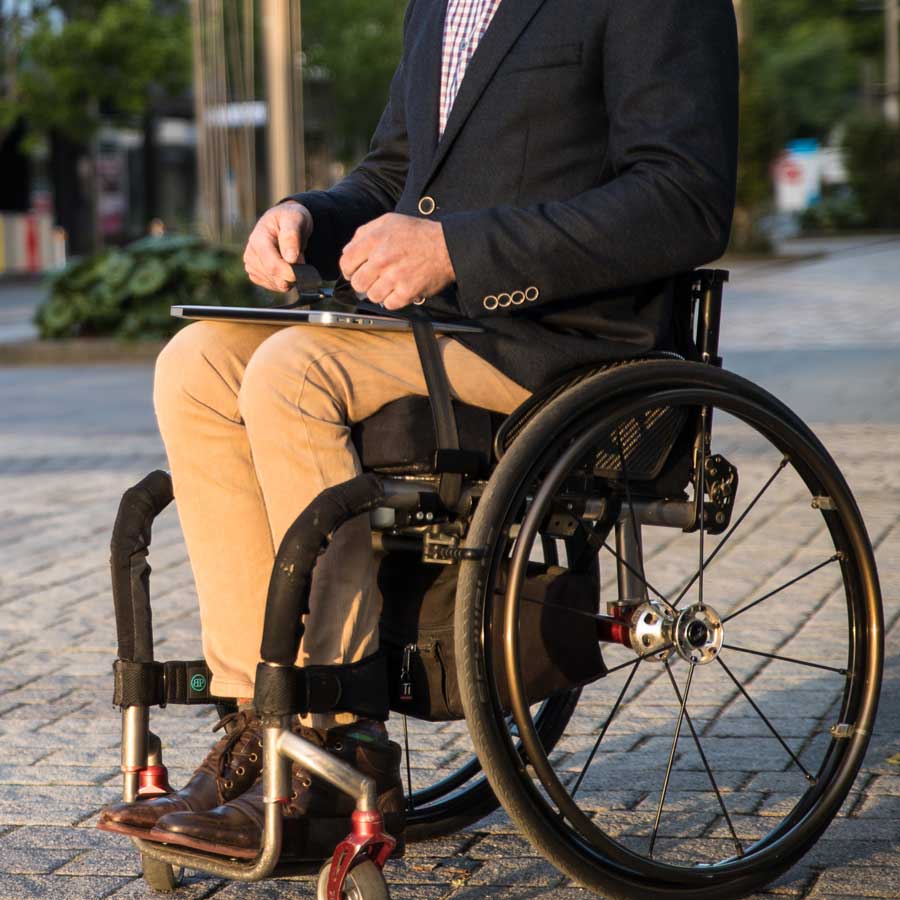
These four names of power add-ons get thrown around like they're doing the same job, but they're not. They all help with different jobs, terrains, and sit in different categories.
Need help deciding which one is right for you? This article will help. work out which category you're actually shopping in, and the decision gets a lot easier.
The short answer.
Buy a FreeWheel if you want to get onto gravel, grass and packed dirt for a few hundred dollars and you've got the shoulders to push.
Buy a SmartDrive if your problem is distance and hills on hard surfaces, or if you need something that works on a bad day.
Buy a Batec if you want real off-road capability while staying in your own chair.
Look at a Bowhead only if you want to ride mountain bike trails and you're happy to transfer out.
Four options, four different jobs.
Mechanical front attachments - FreeWheel
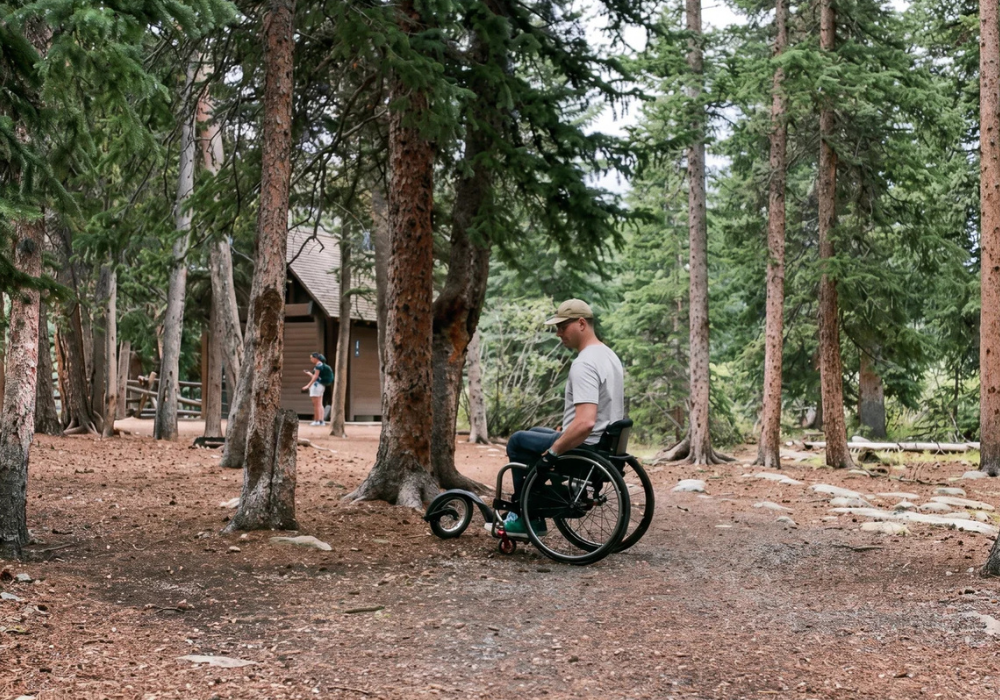
A FreeWheel clamps onto your chair, swivels around, and lifts your front casters clear of the ground. Your chair becomes a trike: two rear wheels doing the work, one big wheel out front rolling over rough terrain.
Rear-mounted power assist - SmartDrive
SmartDrive sits behind your rear axle and pushes. It's brilliant at what it does, and what it does is reduce how many pushes you need over distance and up hills.
Your casters are still on the ground and catching every crack and patch of soft gravel. Power assist solves an endurance problem. It does not solve a terrain problem.
It has one big advantage the powerbikes don't, which we'll get to further down.
Front-docking power bike- Batec
A Batec clips onto the front of your chair and takes over steering and drive. You're still in your own seat, your own cushion, your own setup. The front wheel is big, the motor is serious, and the good ones will climb all sorts of hills.
But, you're also lifting a 17 kg unit every time you use it, and working out where it lives when not in use.
Standalone adaptive bikes Bowhead
Bowhead is a mountain bike. It has suspension, a harness seat, and a motor that gets around any hills. It is a magnificent bit of kit.
It’s a standalone bike that you transfer into, leaving your wheelchair at the trailhead. If you were searching for a wheelchair attachment, this is not one. It is also 40-odd kilos and massive; you’ll need a shed or garage to store it.
|
Option |
What it actually is |
Powered |
Rough weight |
Ballpark cost |
|
FreeWheel |
Mechanical front wheel that raises your casters. Helps with rough terrain. |
No |
About 3 kg |
US$600 to $900 |
|
SmartDrive |
Motor that mounts behind your rear axle and pushes from the rear. |
Yes |
Around 6 kg |
US$6,000 plus |
|
Batec |
Electric powerbike that docks to the front of your chair |
Yes |
17 kg and up |
$6,000 and $14,000 USD |
|
Bowhead |
Standalone adaptive e-trike you transfer into |
Yes |
40 kg plus |
High end, specialist equipment. |
Three of those attach to the chair you're already sitting in. One replaces it for the duration of the ride.
Pros and cons at a glance.
|
Option |
What's good |
What's not |
|
FreeWheel |
Cheap. Light. Fits almost any rigid or folding frame. Clips on and off in seconds once it's set up. |
You’re still pushing. It makes rough ground possible, not easy. Changes your seating angle slightly. Initial fitting takes about 15 minutes, and folding frames usually need an adapter. |
|
SmartDrive |
Light for what it is. Long range on hard surfaces. Your chair's footprint barely changes, so it still works in the house, the office and small shops. Good on a bad day. Easy to load in a car or take with you. |
Doesn't lift your casters, so it doesn't fix rough ground. Expensive. Weaker on hills and rough terrain than a powerbike. Attaching and detaching can be fiddly, and if you can't reach behind you it's a problem. |
|
Batec |
Genuine off-road capability. You stay in your own chair with your own cushion. One-click docking that most people manage alone. Long range. Handles dirt, gravel, forest track and steep ground. |
Heavy to lift into a car. Expensive. Needs somewhere to live. Too big for the house, the office and small shops. Sustained use can be hard on your neck, arm and back. Quoted range figures assume flat ground and a light rider. |
|
Bowhead |
Proper mountain biking. Full suspension, huge power, leans through corners. Goes places nothing else here will go. |
Not an attachment. You leave your chair behind. Needs a vehicle rack or trailer. Recreation equipment, not mobility equipment, so likely not funded. |
Which one suits your ride.
|
If this is your day |
Best fit |
Why |
|
Footpaths, shops, the occasional grass verge or gravel driveway |
FreeWheel |
Cheapest thing that solves the caster problem, and it comes with you everywhere |
|
Around the house, the office, small shops, then a long push home |
SmartDrive |
Keeps your footprint the same, so it works indoors. A powerbike won't |
|
Long distances on sealed paths, hills on the way home, you arrive wrecked |
SmartDrive |
Helps with endurance and reduces strain on your body. |
|
Forest tracks, farm tracks, beaches, dog walks, the commute |
Batec |
Nothing else here does this while keeping you in your own seat |
|
You need something that works on your worst days, not just your best |
SmartDrive or powered wheels |
A powerbike asks a lot of your body. See below |
|
Mountain bike trails, downhill, riding with mates on MTBs |
Bowhead |
The only option here built for it |
|
You're not sure yet and the budget is tight |
FreeWheel first |
Lowest cost to find out what you actually want. Resells well too |
Can you actually live with it?
This is where most buying guides stop being useful, because the spec sheet says nothing about your front door.
Gem put it better than I could: you can pick the perfect add-on on paper and still find it doesn't fit your life. She bought her first Batec secondhand in 2020, it was large, a bit battered and bruised, and loved it. Then she found it didn't quite fit her lifestyle; she found it was too big and didn't fit into doors, cars, and her cupboard. She has since gotten a smaller Batec that better suits her lifestyle.
Here are four questions she considers before committing to an investment.
Can you put it on and take it off yourself?
Gem's whole decision came down to this one. She can dock her Batec with no help at all, every time, and that's what pushed her toward it over the alternatives she'd seen, which she found fiddly and tricky to fit.
SmartDrive goes the other way for some. Most people can get theirs in and out of the car independently, but find the attaching and detaching fiddly. If you can't reach behind your backrest comfortably, test this before you buy.
Can you get it into the car?
Gem can dock her batec faultlessly and still cannot lift it into her car from a seated position. That is not a small thing, and not something the dealer's brochure will tell you.
Work it out in the car park during your demo, from your chair, on your own. If the answer is no, you've just learned that your add-on only works on days when someone else is around, or on trips that start at your front door.
Flying is a separate check. If you're taking it overseas, confirm the battery is flight-safe or that a flight-safe battery exists for it.
Can you get it into the house, and where does it live?
Gem's first powerbike was awkward to get through her front door because of the angle. The smaller one she rides now, she gets in and out independently, and it tucks into the cupboard under the stairs.
Will the battery do what you need?
Gem has never run hers flat, and she's used it for days on end. Some riders do 20 miles and carry a second battery they can swap in seconds.
Work out your longest realistic day, then check the quoted range against it. And take the quoted figure with a grain of salt. Those numbers usually assume flat ground, no wind, a light rider and a steady speed, which is not a forest track.
What it costs your body.
Gem can't use her powerbike all day, every day. The throttle position puts strain on her neck, her hand and her arm. The vibration travels. Sitting in that riding position starts to hurt her back over long stretches. She has hypermobility, so things trigger more easily for her, and she's clear that she had no idea any of this would happen when she bought it.
She also raises something that will be familiar to a lot of people with spinal cord injuries: vibration and sustained position can set off nerve pain. The point is that "can I afford it" is the wrong first question. The real one is "what will this ask of my body”
Where Mike and Gem land differently.
Gem found one machine that fits her lifestyle and activities. I went the other way and ended up with a tool for each job.
I use three of the four on this list. They each have pros and cons; for me there is not one machine that does everything.
Neither of us is right. It's mostly a function of what we want out of a week. Hers has to work for dog walks, the commute and the day-to-day, so portability and one-click docking matter enormously. Mine splits cleanly into ordinary days and adventure days, so I was happy to accept a machine that only handles the second kind.
The useful bit for you is this. Don't ask which of these four is best. Ask how many different jobs you're trying to do, and be honest that the answer might be more than one.
SmartDrive, for the ordinary weekday errand.
I live somewhere with hills. Not dramatic ones, nice paved pathways and relatively smooth slopes. But still, slopes, the sort that turn a ten-minute trip into a decision about whether you really need that errand done.
SmartDrive handles that. Down to the cafe and back, easy. The climb home that used to be the reason I drove instead of pushed now solved with SmartDrive. It's on the chair, it's tucked out of the way, and I don't think about it.
SmartDrive is not an off-road device. It pushes from the rear of your chair; your casters stay on the ground, and the moment the surface goes loose or rutted, you're stuck.
FreeWheel, for walking tracks.
Clip it on, get out on a walking track, do a few kilometres and come home feeling like i’ve done a nice workout.
It also has a ceiling, and the ceiling is my endurance. A few kilometres is good. A long excursion is a different question, and the answer is usually no. There's no motor in it and your pushing every metre.
Bowhead, for actually going somewhere.
I love being outside, properly outside. For a full day, or for several.
That's what the Bowhead is for. Tracks, off-road, an afternoon ride when the weather turns good, or when its not. And multi-day trips when I can get the time. It goes places the other gear can't get near, and it's the reason I've seen country I'd otherwise only have read about.
I wrote about riding the Old Ghost Road here, if you want to see what a multi-day trip on one actually looks like read more about it here.
The trade is the one I flagged earlier. I'm not in my wheelchair when I'm on it. It's a bike, and it lives for the good days and the big plans, not for getting to the shops.
The cheapest upgrade.
Gloves.
Not cycling gloves, not the fingerless ones with the gel pads. Simple and plain leather-palmed work gloves from the hardware store.
Push a handrim across two hours of gravel and dust and your palms will tell you about it for days. Leather takes the heat and the grit instead of your skin. It also means you can grab the tyre itself to slow down on a descent without shredding your hand, which on loose ground you will want to do.
Technique beats gear more often than you'd think.
A few things that took me longer to work out than they should have.
Approach ruts at an angle. Straight on, your front wheel drops in and stops. At maybe thirty degrees, one wheel at a time crosses it and you carry through.
Momentum is free. On soft ground, sand or deep gravel, stopping is the expensive part. Get moving before you hit it and keep the pushes long and smooth rather than short and hard.
Lean back on the drop-offs, forward on the climbs. Obvious once you've done it. Less obvious at speed with a bag on your lap.
Want to know more about wheelies? Check out our blog post about The 3 types of wheelchair wheelie: techniques and real-world use
How to buy one without wasting the money.
Gem's route is a good template, so here it is.
Research properly, then go in person. Watch the videos, read everything, then get to a disability show if there's one near you. At those events, you can bump into more people shopping for add-ons, or who already have one. You can talk to every dealer in one afternoon.
Talk to people who own the one you want. This barely existed twenty years ago. Now there are people on YouTube, Instagram and Reddit, riding every one of these in real conditions. Read their reviews, and most of them will answer a message. Ask them what annoys them about it, not what they love.
Demo it on your terrain, not theirs. Gem notes that her dealer will meet you at a park, a beach, your house, wherever you actually want to ride. Take that offer. An hour on real ground tells you more than a month of comparison tables, including this one.
Buy second-hand without much fear. Gem's first powerbike came off a second-hand disability equipment site, battered but working, and she was really happy with it. FreeWheels hold up well too. Powerbikes hold their value, which cuts both ways.
Trust your gut, and accept you might get it wrong. Gem knew in her gut a powerbike was right for her, bought one, and then discovered the parts of her life it didn't fit. Her take: it's trial and error, it's expensive error, and you don't know until you try. That's honest, and it's an argument for demoing and buying used rather than for agonising longer.
On funding: most of these are potentially fundable depending on where you live and what scheme you're under, and the rules change often enough that anything I write would be out of date by the time you read it. Ask your OT or your funder directly, and ask specifically whether the item is classed as mobility equipment or recreation equipment. That single classification decides most applications.
One last note.
One last thing from Gem, and it's the note I want to leave you on. She first saw a powerbike more than ten years before she bought one, and the cost held her back. Six years in, she says every single time she clips on she still thinks "woohoo," and her only regret is the years she waited.
Thanks to Gem Hubbard of Wheels No Heels for the honesty about her neck, her car and her cupboard under the stairs. Go and watch her stuff.
I am a T10 complete paraplegic and acknowledge that not everyone has the function I do. Do your best with what you've got and continually look to improve your skills.
Happy Adaptdefying. – Mike

Leave a comment
All comments are moderated before being published.
This site is protected by hCaptcha and the hCaptcha Privacy Policy and Terms of Service apply.