

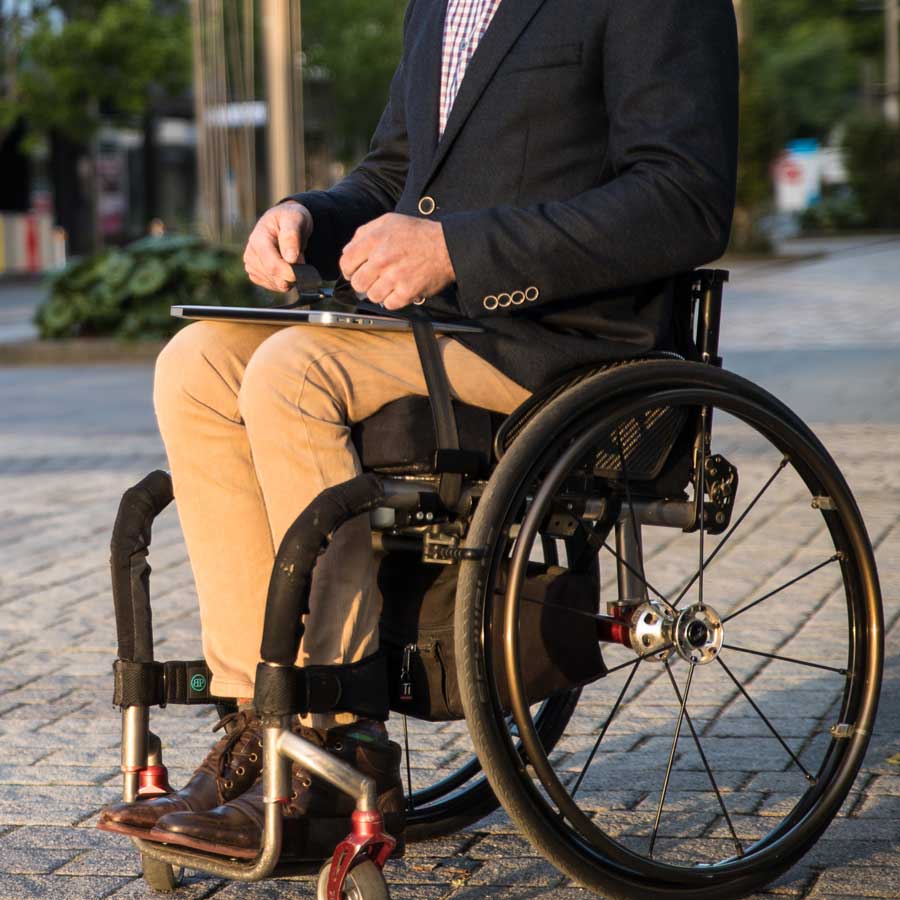

The first version of our underseat bag sold out, in a matter of weeks. You told us what you loved about it, and you told us what you'd change.
So we went back and rebuilt it. Meet the Adaptdefy Underseat Bag for rigid wheelchairs. It's the same idea: turn the dead space under your seat into secure, easy-to-reach storage. Here's what changed, and how each change came from a wheelchair user.
The short answer. The Adaptdefy Underseat Bag for rigid wheelchairs has six upgrades over version 1: colour-coded green and black zips, binding and double stitching on the straps, a larger gusseted front pocket, rounded corners, three sizes covering 11 to 22 inch chairs, and four quick-release buckles that let you remove the bag while seated.
Version 1 compared to the new Underseat Bag.
| Feature | Version 1 | Adaptdefy Underseat Bag for rigid wheelchairs |
|---|---|---|
| Sizes | One size | Small, Medium, Large |
| Chair width range | Single fit | 11 to 22 in (280 to 560mm) |
| Capacity | One capacity | 7 to 16 litres across the range |
| Weight | Not listed | 264 to 432g |
| Removal | Undo the Velcro straps | Four quick-release corner buckles, straps stay on the chair |
| Zips | Single colour | Colour-coded: green main pocket, black front pocket |
| Front pocket | Standard, a tight fit for large phones | Gusseted, fits the largest phones |
| Straps | Standard stitching | Internal binding and double-stitched seams |
| Corners | Square | Rounded |
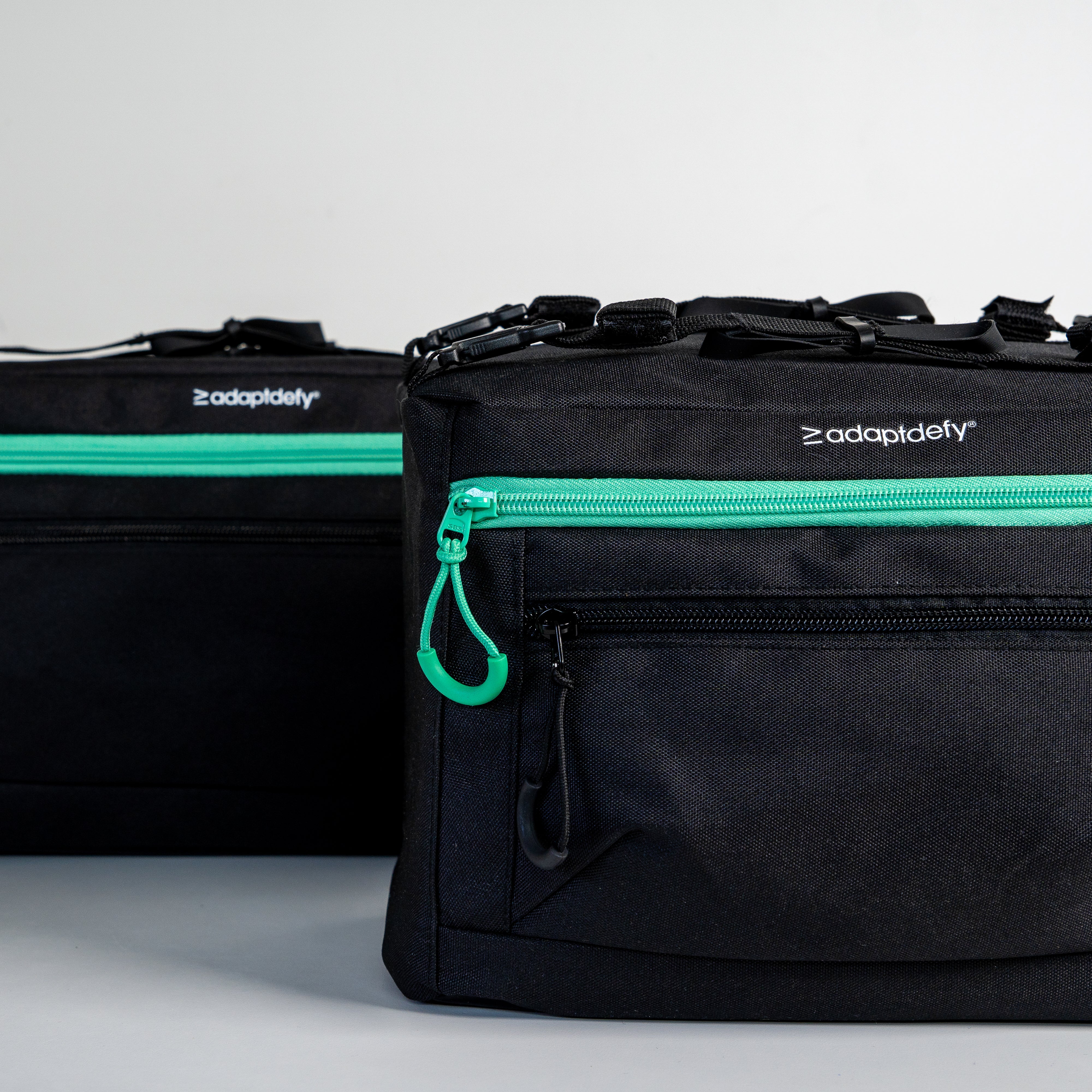
1. Our signature green zip.
You can't see under your own seat. Not properly, not without leaning over and twisting around, and that assumes you can lean over at all.
On version 1, finding the right pocket meant feeling your way there and hoping. Now the main compartment has Adaptdefy's signature green zip and the front pocket has a black one. Green means main, black means front. You find the right pocket by glance or by touch, without bending down to check. Every zip also has a finger loop, so it opens with limited grip or strength.
One line from our customer research stuck with me: "I can't see into it, so I need to identify items by touch." Read that back and the colour coding stops being a nice detail and starts being the whole point.
2. Binding and double stitching.
The straps take the load. Every bump, every kerb drop, every time you overpack the thing with groceries because you told yourself you'd only get three items.
We added internal binding and double-stitched the seams at the strap attachments. It's stronger where it needs to be, and it finishes the bag off properly at the same time. Version 1 was solid. This one is built to take a beating and still look like something you chose rather than something you were issued.
3. A much bigger front pocket.
Phones got bigger. Our front pocket didn't.
It's now gusseted and considerably larger, so even the biggest phones slide in without a fight. Phone, wallet and keys live in the front pocket where you can reach them in a second, and the main compartment stays free for everything else.
If you've ever tried to wrestle an oversized phone out of a too-tight pocket while balancing a coffee, you already know why this mattered.
4. Rounded corners.
This one is about how the bag looks and feels.
Square corners read as medical equipment. Rounded ones read as a bag you'd actually buy. Your chair already gets enough attention without your storage looking like it came from a hospital supply catalogue. Rounded corners also mean no sharp edges catching on your legs, your frame or your trousers.
We adapt plenty. We shouldn't have to settle on how our gear looks.
5. Three sizes instead of one.
Version 1 came in one size. Wheelchairs don't.
The new bag comes in Small, Medium and Large, fitting most manual rigid wheelchairs with an outside width of 11 to 22 inches (280 to 560mm). It holds 7 to 16 litres across the range and weighs 264 to 432g. Small suits narrower frames. Medium suits most manual chairs. Large suits wide seat bases and bigger loads, and takes a laptop up to 15 inches.
To find your size, measure from the outside of one frame tube to the outside of the other, then check the sizing matrix on the product page. There's overlap between sizes, so more than one may work for your chair. If you're not sure, send us a photo and we'll confirm before you order.
Using a folding chair? We made a bag specifically for you. Read about the Adaptdefy Underseat Bag for folding wheelchairs.
6. Four quick-release buckles you can use while seated.
This is the biggest one.
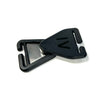
Version 1 meant getting to the Velcro to get the bag off. Now there are four quick-release corner buckles. Unclip them, lift the bag onto your lap, and the two mounting straps stay exactly where they are on your chair.
Airport security. Repacking. Digging for something at the bottom of the main pocket. Transferring into a car and wanting the bag with you. Four clicks and it's on your lap. No bending, no twisting, no Velcro-wrestling on the floor of a departure lounge. See how I use the buckles at the airport in 4 clever ways to use an Adaptdefy underseat wheelchair bag.
Another line from the research: "Not everyone can bend over to an under-seat bag." For anyone with limited core stability, spastic legs or limited dexterity, this is the difference between a bag you use and a bag you gave up on.
Built by wheelchair users, for wheelchair users.
None of these upgrades came out of a design meeting. They came out of customer emails, survey answers and my own frustrations with a bag I helped design.
A few more things worth knowing:
- Fits in seconds. Two adjustable Velcro straps go over your seat base. No tools needed.
- Adjusts to your height. Set it to hang higher or lower, so it usually clears LapStacker, a rigidiser bar or a power add-on.
- Stays balanced. The bag sits under your centre of gravity, not behind you like a backpack, so it won't pull your chair off balance during a transfer.
- Water-resistant. The fabric protects against rain and spills, and the lining wipes clean.
Want the full feature list? Read 10 reasons you need an Adaptdefy bag.
The last batch sold out in a matter of weeks. If you've been waiting for a size that fits your chair, this is it.
Shop the Adaptdefy Underseat Bag for rigid wheelchairs
Frequently asked questions.
What changed from version 1 of the Adaptdefy underseat bag?
Six things: colour-coded green and black zips, binding and double stitching on the straps, a larger gusseted front pocket, rounded corners, a range of three sizes, and four quick-release buckles that let you remove the bag while seated.
Which size underseat wheelchair bag fits my chair?
Measure the outside width of your chair, from the outside of one tube to the outside of the other, and check it against the sizing matrix. Small suits 11 to 14 inch chairs, Medium suits 15 to 17 inch, and Large suits 18 to 22 inch. There's overlap, so contact us with a photo if you're unsure.
Can I take the underseat bag off while seated?
Yes. Unclip the four corner buckles and lift the bag onto your lap. The mounting straps stay on your chair, so there's nothing to refit afterwards.
Can I swap between bag sizes?
Yes, if your chair's width fits more than one size. The buckles work across all three rigid sizes, so you can clip on a bigger or smaller bag depending on your day. Here's how one customer does it.
Will a laptop fit in the underseat bag?
That depends on the size of your laptop. The Medium holds tablets and compact laptops. The Large fits laptops up to 15 inches. The bag isn't padded, so use a laptop sleeve.
Can I use the bag with LapStacker?
Yes. The bag works with LapStacker without interfering with your chair. The quick-release buckles let you remove the bag while the mounting straps stay attached.
Is the underseat bag waterproof?
No. It's water-resistant. The fabric protects your belongings from rain and spills, and the lining wipes clean. It's not insulated and shouldn't be machine washed.
I'm a T10 complete paraplegic and I know not everyone has the function I do. Do your best with what you've got and continually look to improve your skills.
Happy Adaptdefying.
– Mike
About the author.
Mike Brown is a T10 complete paraplegic and co-founder of Adaptdefy. He has spent 14 years living, problem-solving and building as a wheelchair user, and every product Adaptdefy develops is shaped by that experience. Adaptdefy's mission is to solve everyday, real-world problems for wheelchair users and the adaptive community.


Leave a comment
All comments are moderated before being published.
This site is protected by hCaptcha and the hCaptcha Privacy Policy and Terms of Service apply.