



Quick answer: To do a wheelchair wheelie, place your hands at 10–11 o'clock on the handrims, roll back slightly, then push sharply forward to 2 o'clock. Your front casters will lift off the ground. Think of it like a clock face. How high they go depends on how hard you push and where your centre of gravity sits, something only you can feel.
A wheelchair wheelie is the skill of balancing a manual wheelchair on its two rear wheels with the front casters lifted off the ground.
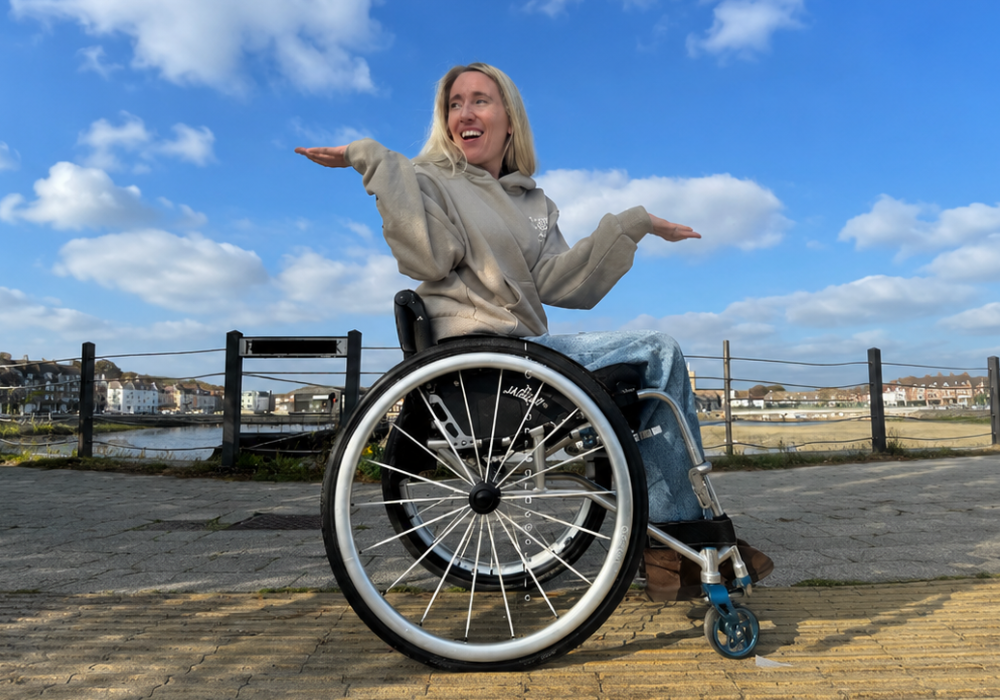
So many of you told us you want to learn how to wheelie in your wheelchair, but didn't know where to start. Here's a beginner's guide to wheelies from wheelchair users with 10+ years of experience.
A wheelchair wheelie is one of the most useful wheelchair skills you can develop, and more accessible than it looks. You don't need to be an athlete or have years of experience in a chair. You need the right technique, a spotter, and a bit of patience. Here's the breakdown.
Before you start learning a wheelie.
Setup matters more than most people expect. A few things to check before your first attempt.
Anti-tip devices.
Keep them on while you're learning. They stop a backwards overshoot turning into a backwards fall. Remove them once you're consistently finding the balance point.
Get a spotter.
Have someone you trust stand behind you. Not to interfere, just to be there. Knowing someone has your back lets you push a little further without fear. If you do overshoot, they catch you. That confidence is worth more than you'd think.
Find the right space.
Flat ground, clear space behind you. Grass is more forgiving than concrete if you fall, so if you have the option, start there.
Check your tyre pressure.
Under-inflated tyres make the pop feel sluggish and the chair respond unevenly. Check both sides are equal before you practice. It makes a real difference.
How to pop a wheelie on a manual wheelchair?
Step 1: Position your hands.
Start at 10–11 o'clock on the handrims. Fingers wrapped under the rim, not gripping the top. Keep it light. You're going to feel the balance point through your hands, and a tight grip cuts off that signal completely.
Step 2: Use a backward rock.
Don't push from a dead stop. Roll back a few centimetres first, then immediately push forward hard. No pause between the two movements. That backward rock loads the motion and gets the casters up with far less effort than starting stationary.
Step 3: Let the casters lift.
As you push forward, let your weight settle back slightly into the seat. The front casters will come up. Your only goal for the first few attempts is to feel that lift. Not to hold it, not to balance. Just feel what it's like when the front end comes off the ground.
Step 4: Find the balance point.
Slightly past the point where the casters lift, there's a spot where very little force is needed to stay up. Keep your hand movements small, between 12 and 1 o'clock on the rim. Tipping forward? Push forward. Tipping back? Pull back. Let the rim slide through your grip when you need more range.
Step 5: Land it.
Pull back gently on the rims, or lean your chest slightly forward. The casters come down. That's a wheelie.
Common mistakes and how to fix them.
Gripping too tight.
The balance point communicates through your hands. If you're white-knuckling the rim, you can't feel it. Loosen your grip. Your hands should be able to slide along the rim freely.
Leaning forward on take-off.
When you feel yourself going back, instinct says lean forward. Fight it. Leaning into the push works directly against you. Let your weight go back into the seat. Trust the motion.
Starting from a dead stop.
Harder than it needs to be. Use the backward rock every time: roll back slightly, then push forward immediately with no gap between the two. The difference in effort is significant.
Overshooting and freezing.
If you tip too far back, tuck your chin to your chest and pull hard on the rims. Your spotter is there in the early sessions. Over time, that recovery becomes reflex and you stop thinking about it. Most people feel it click faster than they expect.
How long does it take to learn a wheelchair wheelie?
Popping the casters, most people get there within two or three sessions. That part is more accessible than it sounds.
Holding the back-wheel balance is a different skill. Expect two to eight weeks of consistent practice, 10 to 20 minutes a few times a week, before it feels controlled rather than accidental. Like any wheelchair skill, it is pure muscle memory. The more repetitions, the faster it clicks.
The bunny hop, a quick caster lift and land, is often workable within a week. Height and hold time build from there.
Take it slow. Know your limits. How hard you need to push, and how your centre of gravity works with or against you, is something only you can feel. Every chair is different. Every body is different.
How to fall safely if you tip backward.
It happens. Even experienced wheelchair users overshoot occasionally. Knowing what to do in the moment makes the difference between a controlled landing and an injury.
What to do
Don't put your hands out behind you. Instinct says to reach back to break the fall. Resist it. Backwards falls with outstretched arms cause wrist fractures. Keep your hands on the handrims or close to your body.
Tuck your chin to your chest. This protects your head and neck. It also prevents the back of your skull from hitting the ground. Do it immediately, as soon as you feel the overshoot.
Stay loose. A tense body absorbs impact badly. Let the chair take it.
Practice it deliberately. In your early sessions, with your spotter directly behind you, intentionally overshoot from a very low height and let yourself fall in a controlled way. Do it a few times. Once you know what a backward fall feels like and that you can come out of it fine, the fear of tipping back mostly disappears. That fear is often what stops people from pushing far enough to find the balance point.
For spotters: Step back and lower gently rather than trying to stop the fall entirely. Catching a full backwards fall puts strain on both of you. A controlled lower to the ground is safer than a blocked fall.
Ready to go further: Learn the 3 types of wheelchair wheelies.
The steps above teach you the fundamental wheelie. But there are actually three distinct types, each with its own technique and real-world use, from the quick bunny hop for clearing obstacles to the full back-wheel balance for slopes, rough ground, and carrying things hands-free.
Read our guide to learn more about these types of wheelies.
Frequently asked questions about learning wheelies.
Got more questions about wheelies in a wheelchair? Here are the ones we hear most.
Can anyone learn to do a wheelchair wheelie?
Most manual wheelchair users with enough upper body strength can. How quickly you progress depends on your injury level, core stability, and shoulder function. The technique is the same for everyone; the pace of learning varies.
Do I need a special wheelchair to do wheelies?
No. Rigid-frame chairs are easier because they have less flex and respond more directly to your movements. Folding chairs work too. The technique doesn't change.
Should I use anti-tip devices when learning?
Yes. Keep them on until you're consistently finding the balance point and your spotter has backed well off. They exist for exactly this stage of learning.
What if I keep falling backwards?
Tuck your chin to your chest and pull back hard on the rims. That's the recovery reflex. Practise it intentionally with your spotter close by. Once you've done it a few times, the fear of overshooting mostly disappears.
Can I do a wheelie in a power wheelchair?
No. Power wheelchairs are too heavy and the mechanics don't allow it. This guide is for manual chairs only.
About the Author
Adaptdefy is a wheelchair accessories and education brand founded by wheelchair users to serve wheelchair users. Adaptdefy’s mission is to solve everyday, real-world problems for the adaptive community. We believe that knowledge, innovation and community can help you adapt, defy and thrive, regardless of your situation.
Adaptdey was founded from lived experience after Mike Brown sustained a T10 complete spinal cord injury in 2012. Since then, he has spent over a decade developing practical knowledge of wheelchair skills, adaptive techniques, and the daily realities of wheelchair life.
Adaptdefy's flagship product, LapStacker, is the world's first and only patented retractable carry system for wheelchairs, developed by Mike to solve a problem he encountered daily. It is used by wheelchair users across more than 40 countries.
Mike has formed a team of Adaptdefiers, who write and contribute to the Adaptdefy blog covering wheelchair skills, techniques, gear, and independence, drawing on personal experience and sharing first-hand experience of wheelchair life. All in pursuit of living a greater than life.

Leave a comment
All comments are moderated before being published.
This site is protected by hCaptcha and the hCaptcha Privacy Policy and Terms of Service apply.