

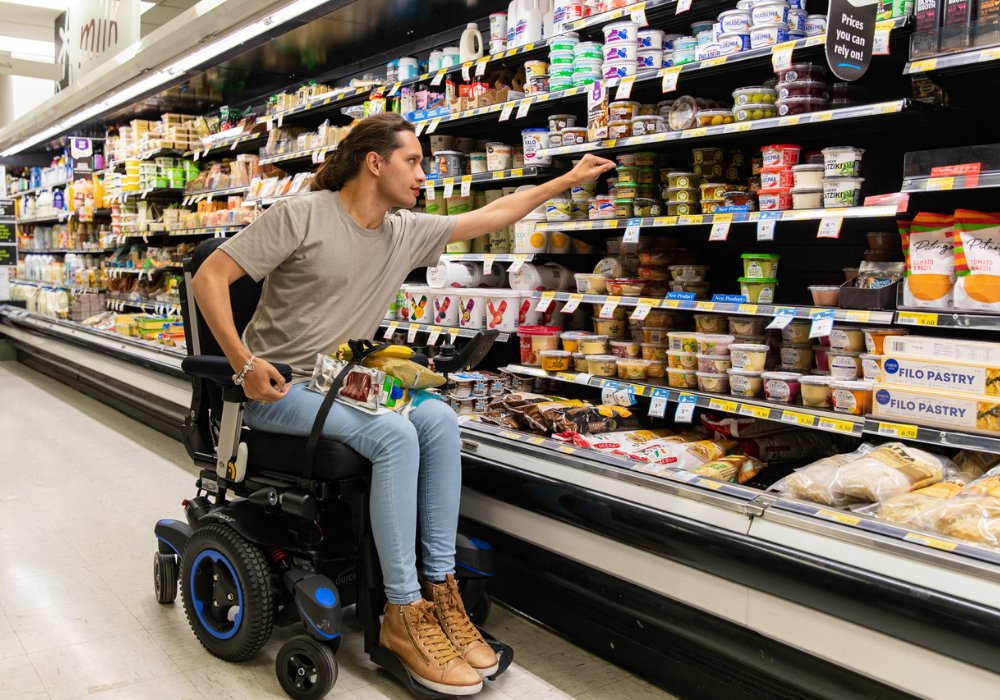
Shopping as a wheelchair user is one of those tasks that looks simple from the outside. You grab a trolley, you go around the store, you pay, you leave. Easy, right?
For wheelchair users, it's rarely that simple.
I've been doing this for years. These are the wheelchair user grocery shopping tips that made the biggest difference for me.
How to grocery shop in a wheelchair?
The right tools make a real difference; LapStacker and an underseat wheelchair bag together solve most of the carrying problem. The rest is planning: a good list, a store you know, a cart you've already tested.
And if you've got a tip that works for you, drop it in the comments. Someone reading this right now probably needs exactly what you've figured out.
1. Organise your list by aisle.
Backtracking burns energy. If you're zigzagging because your list is written in the order you thought of things, you're adding distance and time you don't need.
Before you go, group your items by section: produce together, dairy together, and cleaning products together. Most major supermarkets have an app now that lets you organise your list by aisle automatically.
2. Use LapStacker to carry groceries hands-free.
This is my best tip for grocery shopping as a wheelchair user.
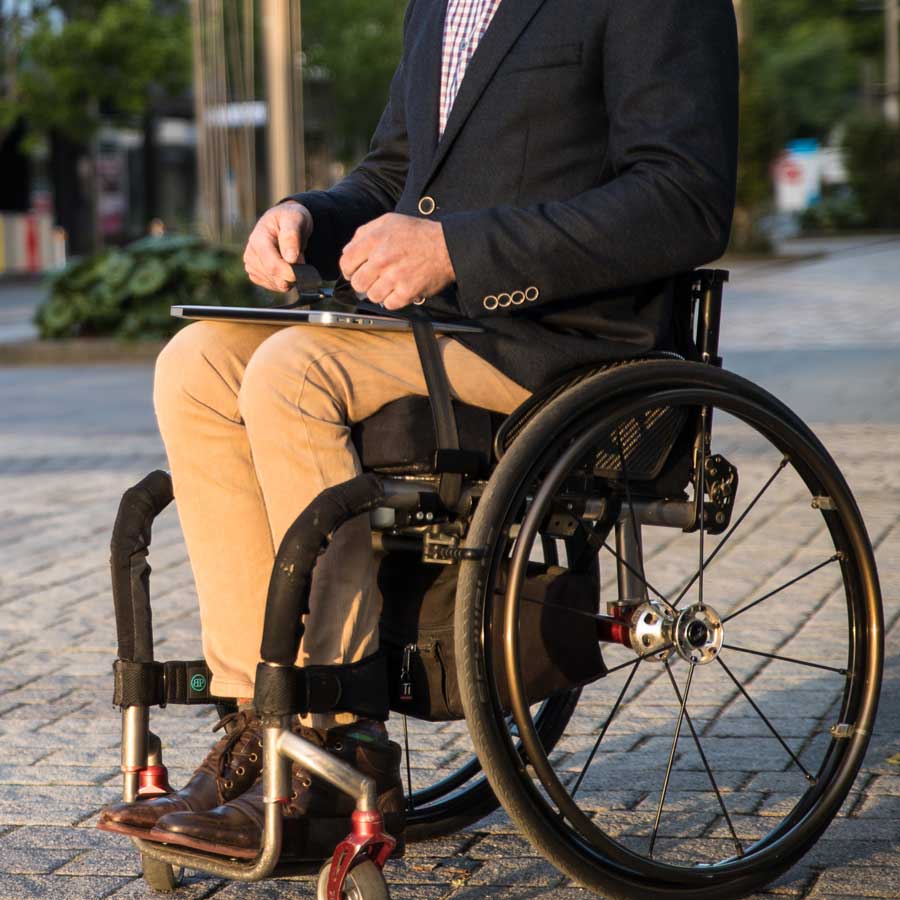
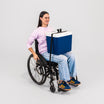
Whether you're using a trolley, a basket, or just wanting to carry things on your lap in a wheelchair, LapStacker handles it. If you're asking how to carry groceries in a wheelchair without piling things precariously or asking someone to push the trolley for you, this is the answer. See How to carry groceries in a wheelchair without dropping them.
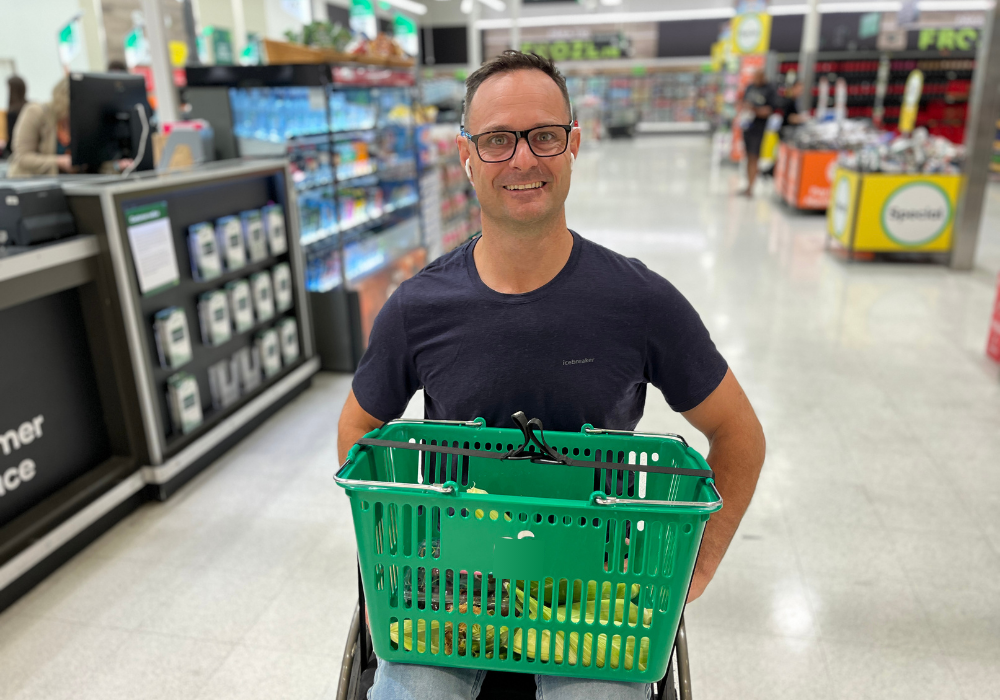
LapStacker is the world's first and only retractable carry system for your wheelchair. At the store, it holds your smaller items, your basket, your bag, your phone, whatever you're working with, securely on your lap while your hands stay on your wheels. The magnetic buckles clip and release in seconds. It's how grocery shopping in a wheelchair is made easy.
See it in action. Read more here about how Wayne uses LapStacker to grocery shop independently. Calling it a "game-changing” product for wheelchair users
3. Get your essentials off your lap with an underseat wheelchair bag.
LapStacker holds your shop. Your underseat wheelchair bag holds everything else.
Your wallet, your phone, your keys, your headphones. Things you need quick access to but don't want taking up lap space mid-shop. An underseat wheelchair bag keeps them within reach, out of the way at checkout, and off your lap entirely.
Keep a collapsible bag tucked in there, for larger shops. You'll be glad you did when you get to the checkout and realise you're staring down twelve items with nowhere to put them.
4. Scout the store before a big shop.
Not all supermarkets are the same. Aisle width, shelf height, checkout lane accessibility, and the location of the accessible trolleys it varies a lot, and finding out mid-shop that the checkout is too narrow is a frustration you don't need.
If you're trying a new store, do a light run first. Grab a few things, get a feel for the layout, and note what works and what doesn't. Your next visit will be significantly smoother.
5. Pick the best cart for you.
Did you know that wheelchair users can use regular shopping carts? Push your wheelchair with one hand while steadying the shopping cart with the other. Alternatively, some stores offer carts designed to attach directly to a wheelchair.
Wheelchair-accessible trolleys vary by model and store. The width, the fit, how it handles with your chair; none of it is standardised. Some are great. Some feel like you're trying to steer a shopping cart attached to a boat.
Check out our breakdown of Wheelchair Accessible vs. Regular Shopping Carts
6. Ask for help when you need it.
If the accessible trolley is stacked somewhere you can't reach, an aisle is blocked, or the checkout lane is too narrow, ask. Most staff are happy to help, and it's faster than navigating it solo when the layout's working against you.
This isn't about needing help. It's about using the resources available so you can focus on the actual shop.
7. Talk to the store if something's wrong.
If the accessibility is genuinely poor, say something. Crowded displays blocking aisle space, ramps that don't work, accessible carts that are consistently inaccessible, stores respond to direct feedback more than most people expect.
You're also making it easier for every wheelchair user who comes in after you.
8. Don't shop hungry.
You already know this one. An overloaded basket is hard enough to manage when you planned it. When hunger's driving decisions, it gets out of hand fast.
How to carry groceries in a wheelchair: a quick breakdown.
|
Situation |
Best solution |
|
Carrying items while rolling |
LapStacker - holds bags, baskets, loose items on your lap |
|
Wallet, phone, keys mid-shop |
Underseat wheelchair bag |
|
Bigger shops with lots of items |
Collapsible bag in your underseat bag, standard trolley with LapStacker |
|
No accessible trolley available |
Ask staff. If consistently inaccessible, give feedback to management |
Frequently asked questions.
What is the easiest way to carry groceries in a wheelchair?
LapStacker is the most practical solution for wheelchair users. It's a retractable carry system that clips to your chair and holds bags, baskets, and loose items securely on your lap while you roll, keeping your hands free. An underseat wheelchair bag handles your phone, wallet, and everyday essentials separately.
Are supermarkets accessible for wheelchair users?
It varies. Most major chains have accessible trolleys, wider checkout lanes, and ramp access, but the quality is inconsistent between stores and even between branches of the same chain. Scouting a new store before a big shop is the best way to know what you're working with.
How to carry groceries in a wheelchair without dropping them.
Stop balancing items on your lap and start securing them. Use LapStacker to secure loose items, or a shopping bag to your lap, and roll on hands-free.
What should I bring to make wheelchair grocery shopping easier?
LapStacker for carrying items hands-free, an underseat wheelchair bag for your everyday essentials, and a collapsible bag for larger shops. A phone with the store's app helps with aisle-organised lists. Beyond gear, a list organised by section is the single biggest time-saver.
Is it easier to shop online as a wheelchair user?
Online shopping is genuinely more accessible for some people, on some trips. But it's not always available, not always reliable, and it removes the independence of doing it yourself. Most wheelchair users I know do both, online when it makes sense, in-person when they want to. The tips above are for making the in-person shop work as well as it should.
Want more?
Check out these related guides:
-
Wheelchair accessible shopping carts vs. regular carts: Which is best?
-
Wheelchair grocery shopping tips. How Mike and Gem do a quick shop.
-
How to carry groceries in a wheelchair without dropping them?
-
"Game changer" How Wayne uses LapStacker to grocery shop independently.


Leave a comment
All comments are moderated before being published.
This site is protected by hCaptcha and the hCaptcha Privacy Policy and Terms of Service apply.