



Grocery shopping is one of those tasks that sounds simple on paper.
But if you use a wheelchair, you know it rarely is. Tight aisles, high shelves, and operating a cart. The simple task of grocery shopping requires careful consideration and planning.
One of the first challenges you encounter is what cart to use. The standard grocery cart? The wheelchair accessible cart? Or something else entirely?
A standard trolley needs one hand to steer and one to push your chair. A wheelchair-accessible cart clips to the front and frees both hands. A basket sits on your lap and skips the trolley bay entirely. Each option changes the shape of your entire shop.
Each option has real advantages and real frustrations, and the right choice depends on your setup, your mobility level, and what kind of shop you're doing.
I've used all three. Some worked better than I expected. One frustrated me in ways I didn't see coming. Here's the honest breakdown, so you can make the call for yourself.
Wheelchair users typically choose between a standard grocery cart, a wheelchair-accessible cart that attaches to the front of the chair, or a basket for smaller shops. Each has genuine advantages and genuine frustrations. The right choice depends on your upper-body function, shop size, and store layout, not a single universal answer.
The standard grocery cart.
The standard trolley wasn't built with wheelchair users in mind. But "not designed for you" and "doesn't work for you" aren't the same thing.
What works well:
- Maneuverability. Standard carts are lighter than accessible alternatives. In tight aisles, around sharp corners, that weight difference matters more than you'd think.
- Separation from your chair. This one's underrated. If you only need one item two metres down the aisle, you can park the cart and zip over independently. You can't do that when the cart is attached to you.
- Availability. Every store, every time, no asking staff, no hunting. It's just there.
- Flexibility. Standard carts come in different sizes and handle everything from a full weekly shop to a quick top-up.
Where it falls apart:
- Pushing two things at once. Maneuvering your chair with one hand while steering a cart with the other is genuinely hard. In a crowded store on a Saturday morning, it can get unsafe quickly.
- Load management. The heavier the cart gets, the harder it is to control one-handed. By three-quarters of the way through a full shop, you're fighting the trolley, and it's winning. That eats energy fast.
- Aisle bulk. A full-sized trolley adds real width when you're already navigating a chair through tight spaces.
The wheelchair accessible shopping cart.
Most major supermarkets carry at least one version of an accessible cart. The most common type attaches to the front of your chair, putting the basket within reach and freeing both hands to propel. Some designs have a built-in seat, either self-propelled or pushed by a carer.
What works well:
- Hands-free movement. You're pushing one unit instead of two. On days when energy is limited, or if you're still building confidence shopping solo, this is a real difference.
- Carrying capacity. Bigger than a hand basket and handles a decent shop without items piling onto your lap.
- Self-supporting. The cart carries its own weight. If lap pressure or skin integrity is something you actively manage, this matters more than people realise. Items aren't sitting on your legs for the duration of a one-hour shop.
- It signals something. When a store stocks these carts and keeps them accessible, it's a sign you're welcome. That's not nothing.
Where it falls apart:
- Difficult to maneuver. The front attachment extends your total length significantly, making corners and tight aisles genuinely frustrating. Many of these carts are also wider than a standard trolley, which makes navigating a busy store and avoiding other shoppers' trolleys harder.
- Reduced reach. Reaching items near the floor or up on higher shelves can actually become more difficult with the cart attached in front of you.
- Visibility. Once the basket starts filling up, your line of sight forward is compromised. In a busy store, this is a real issue.
- Availability. Not every store has one. And even when they do, the accessible cart is sometimes tucked at the back of a trolley bay where you can't get to it independently. A failure that defeats the entire purpose.
- Compatibility. Not all accessible carts fit every wheelchair type or shopping style. The carts can also be temperamental and can detach, which is very frustrating. It's worth checking before you commit to a shop with one.
What are the downsides of wheelchair accessible shopping carts?
The front attachment significantly extends total chair length, making tight corners and busy aisles harder to navigate. As the basket fills, forward visibility is compromised. Not every store stocks them, and when they do, they're often placed where wheelchair users can't reach them independently. Compatibility between cart designs and different wheelchair types can also be unreliable.
Comparing the two: a quick breakdown.
| Factor | Standard cart | Wheelchair accessible cart |
|---|---|---|
| Availability | Every store, every time | Patchy; often placed inaccessibly |
| Hands-free movement | No | Yes |
| Maneuverability | Better in tight spaces | Adds length; harder in narrow aisles |
| Carrying capacity | Large | Medium to large |
| Forward visibility | Clear | Compromised when full |
| Works for solo shopping | With practice | Easier to start with |
So which cart should you choose?
The best shopping cart for a wheelchair user depends on three things: upper-body function (more function makes the standard cart more viable), store layout (tight aisles favour the lighter standard cart), and shop size (bigger shops benefit from an accessible cart's hands-free pushing). There is no single correct answer. Try both.
Here's a more specific breakdown based on your situation.
If you have good upper-body function and you're doing a mid-sized shop: The standard cart is worth learning. It takes practice, especially as the load builds, but the availability and independence it gives you are real advantages. Time your shop off-peak, manage your load, and it works.
If hands-free pushing matters, or you're doing a larger shop: The accessible cart removes one variable. Before you commit to a full shop with one, scout the store first. Check that the accessible cart is actually reachable without asking for help, and get a feel for the aisle widths before you're already halfway through your list.
If you're just grabbing a few things: Skip the cart entirely. A basket, or something better, will serve you more than either option.
What about when you don't need a full cart?
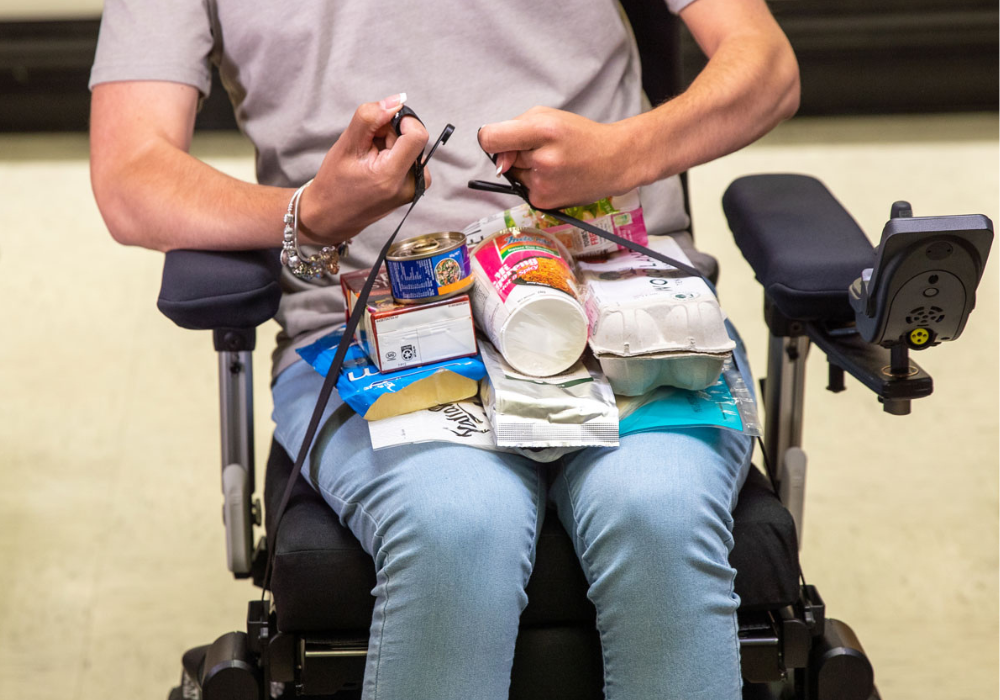
Sometimes the shop doesn't call for a trolley at all. For a smaller top-up, a hand basket works fine on your lap; keep the load light and balanced, heavier items flat on the bottom, nothing tipping toward one side.
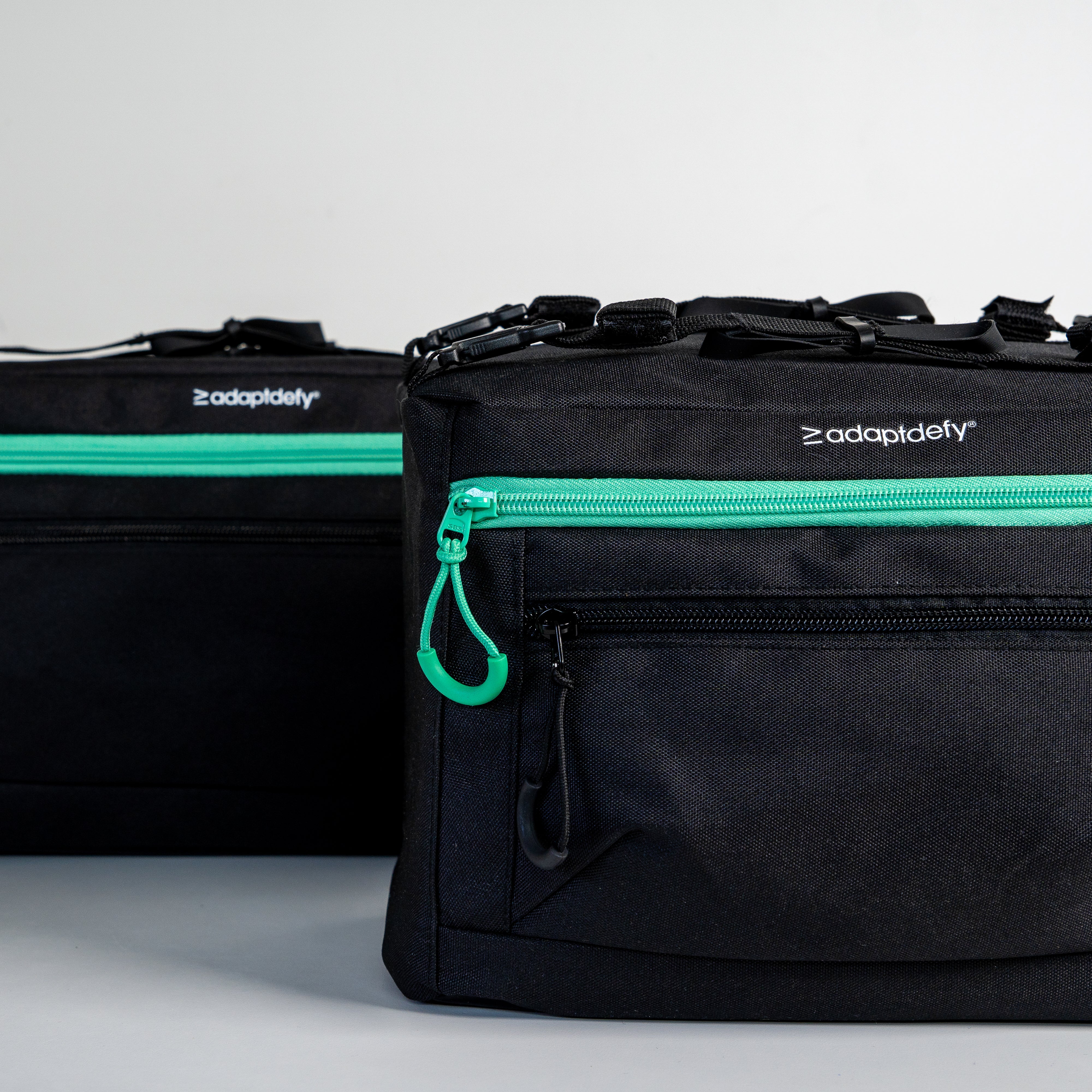
If you're finding the lap balance frustrating, or if pressure is something you need to manage, LapStacker holds your groceries on the way around the store, keeping your lap free and your hands on the wheels. It's what Gem and I reach for on our quick shops. Here's exactly how we do a small shop without a cart.
A few things that make either cart work better.
Whichever option you go with, a few things hold across the board.
Time your shop. Weekday mornings are quieter. Less competition for aisle space, less stress, and staff are more available if you need a hand with something.
Scout a new store before committing to a full shop. Aisle width, checkout lane access, where the accessible cart actually lives, and whether the staff are helpful. A short 10-minute visit on a quick trip saves you a miserable experience on a big one.
Keep your load manageable. For the standard cart, half-full is significantly easier than full. For the accessible cart, watch how high you stack; your forward visibility is the first thing to go.
Ask for help without making it a production. Most store staff are genuinely happy to grab something from a high shelf or retrieve the accessible cart. A simple "could you give me a hand?" is enough. You don't need to explain yourself.
Try both options if you haven't. Form your own opinion. And for a fuller picture of grocery shopping in a wheelchair, from store choice to carrying your load home, the complete guide covers everything else.
FAQ
What is a wheelchair accessible shopping cart?
A wheelchair accessible shopping cart is a modified cart designed to attach to the front of a wheelchair, positioning the basket within the user's reach and freeing both hands for propulsion. Some designs include a built-in seat for users who are accompanied by a carer.
Are wheelchair accessible shopping carts available at all supermarkets?
Not consistently. Most major supermarkets carry at least one, but availability varies by store. Even when they're present, they're not always stored where a wheelchair user can independently access them. Worth checking before you plan a full shop.
Can you use a regular shopping cart in a wheelchair?
Yes. With one hand on the cart and one propelling the chair, standard carts work for most wheelchair users with reasonable upper-body function. The challenge increases as the cart gets heavier. It takes practice, but it's genuinely usable.
What is the best way to carry groceries in a wheelchair?
It depends on your shop size. For large shops, a wheelchair-accessible cart reduces effort and keeps items off your lap. For medium shops, a standard cart works with practice. For small top-up trips, a basket or LapStacker is usually the simplest option.
How do wheelchair users manage heavy grocery loads?
Splitting large shops into smaller, more frequent trips is one approach. Shopping with a companion means they can push the cart while you navigate. Online delivery removes the in-store challenge entirely. For in-store shops, the accessible cart's self-supporting design distributes the load away from your lap.
About the author
Mike Brown is a T10 complete paraplegic, co-founder of AdaptDefy, and the inventor of LapStacker. He sustained his spinal cord injury in 2012 and has spent over 13 years figuring out how to live well in a chair. Everything he writes, comes from his own lived experience. He is also the host of the AdaptDefy podcast, where he interviews wheelchair athletes, adaptive trainers, and access advocates from around the world. He is a T10 complete paraplegic and acknowledges that not everyone has the function he does. Adapt, defy and thrive.


Leave a comment
All comments are moderated before being published.
This site is protected by hCaptcha and the hCaptcha Privacy Policy and Terms of Service apply.