

Before my injury, I loved skiing and being on the mountain. I loved entering a flow state while on the mountain. But in the years after my injury, I tried to do the things I used to enjoy, and if I'm being completely honest, it made me feel worse.
I'd try something and hit a barrier I hadn't thought about. I'd do something that used to be effortless and find it hard, embarrassing and slow.
The turning point for me was discovering sit-skiing and finding the right adaptive equipment to get back out there.
On the mountain: sit-skiing.
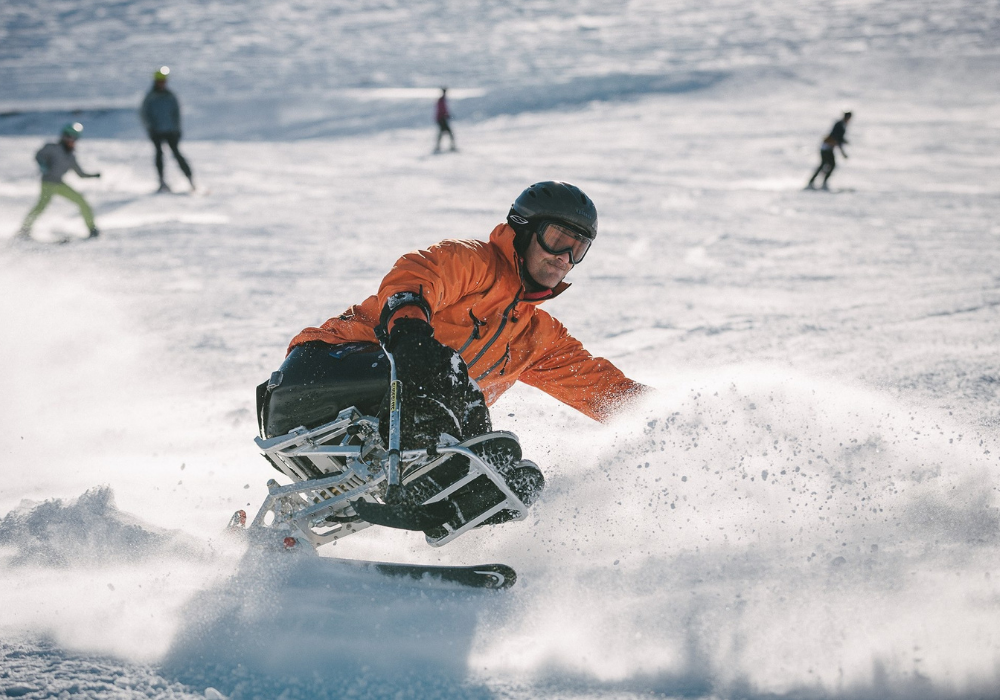
Sit-skiing opened the mountain back up to me in a way I didn't think was possible after my injury. It was a sport I never knew about before, and now it’s one of my favourite things to do.
A sit-ski is essentially a seat mounted on a single ski. Depending on your preference, you can use ski poles to help steer and stabilise, or you can ski with a guide using a tether for control.
For me, skiing is the best flow state I’ve experienced. That's worth every awkward moment to get there.
Getting up the mountain: a DIY T-bar solution.
Mountain lift systems weren't designed with sit-skiers in mind.
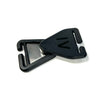
So I came up with my own solution: a custom T-bar setup using a loop of webbing with stainless steel rings on either side, clipped into quick-release buckles.
As the T-bar pulls me uphill, I stay securely connected. When I reach the top, a quick pull releases me cleanly so I can ski on without stopping.
This is one of my favourite examples of what adaptive living actually looks like in practice. Sometimes it's a problem you solve yourself with a bit of creativity and the right hardware.
Rolling in the snow with adaptive tyres.
Pushing a manual wheelchair through snow is one of the more frustrating experiences of winter wheelchair life. You're working twice as hard to go nowhere.
Wheel blades were created by fellow wheelchair user Patrick Mayer. They clip directly onto the front castors of your wheelchair, increasing the surface area and preventing your wheels from sinking into snow or soft ground.
Paired with wider off-road tyres on the push wheels, and a lower pressure gives you a broader contact patch. This helps on soft surfaces, and the difference is significant.
The point of all of it.
Adaptive equipment can remove barriers and level the playing field, so you can focus on the actual challenge of the thing you came to do.
The mountain is still hard, but the equipment just makes sure that your wheelchair isn't the reason you can't access any of it.
What equipment has changed the game for you? Drop it in the comments. I'd love to know.
I am a T10 complete paraplegic and acknowledge that not everyone has the function I do. Do your best with what you've got.
Happy Adaptdefying. – Mike

1 comment
Lynette Carlton
Mike – you are one larger-than-life human being! What an inspiration for others, whether in a wheelchair or not. Love to you and the family.
Leave a comment
All comments are moderated before being published.
This site is protected by hCaptcha and the hCaptcha Privacy Policy and Terms of Service apply.